

How Hyperscale AI Is Reshaping the Power Grid
With AI campuses demanding concentrated, near-continuous power, the grid is evolving rapidly. Compressed timelines, diversified generation, and record-scale investment are reshaping electricity planning and delivery.
Hyperscale AI is redefining how electricity is planned, procured, and delivered, as the surge in AI data center projects compels utilities, grid operators, and equipment manufacturers to compress multiyear schedules into one- or two-year delivery windows.
At the PowerGen International 2026 conference, held in San Antonio from Jan. 20-22, analyst firm Industrial Info Resources (IIR) reported that the US alone has approximately $2.4 trillion in AI data center development underway. While not every project will advance, IIR expects the majority to push through to completion.
From Tens to Hundreds of Gigawatts of New Load
IIR characterized the current moment as a structural, multi-year buildout of digital infrastructure. According to Britt Burt, Senior Vice President of Research for the Power Industry at IIR, US electricity demand has risen from roughly 23 GW of new load in 2023 to about 42 GW today, with another 32 GW under construction.
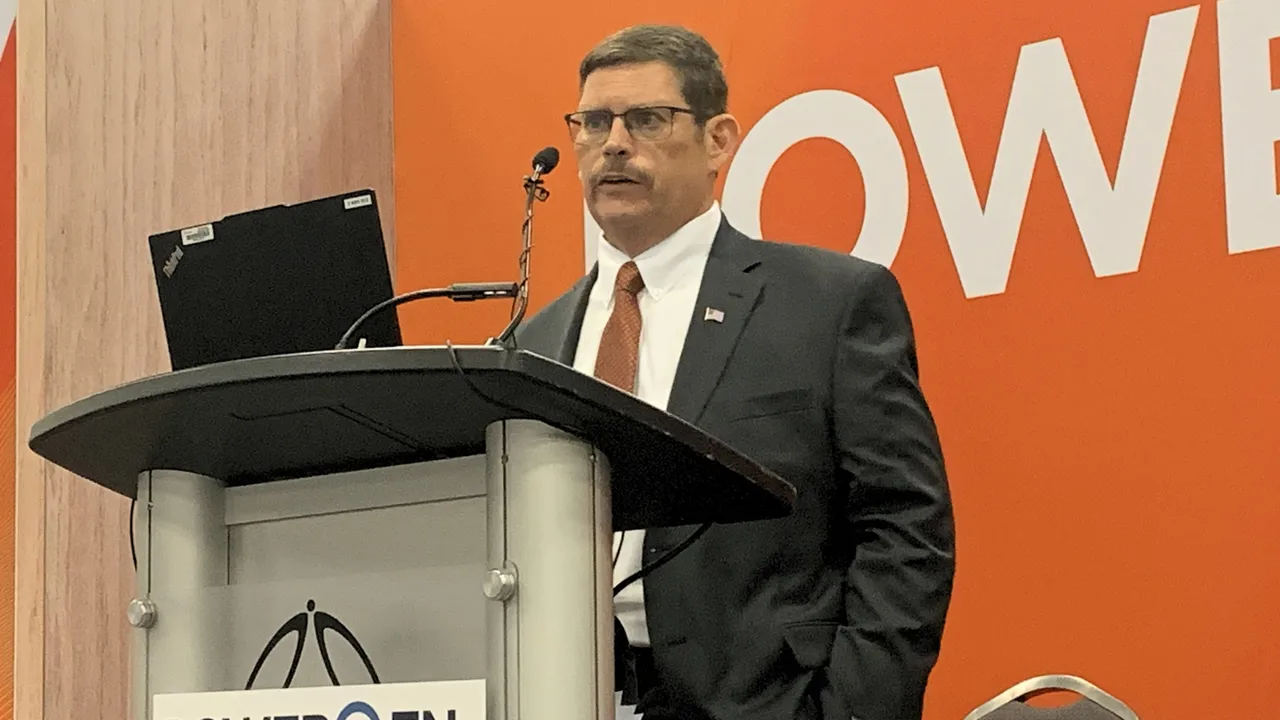
“We are on target to surpass 90 GW by 2030, but some estimates are much higher,” Burt noted at PowerGen. Globally, announced and ongoing data center investment has now reached approximately $3.2 trillion.
These figures are translating into project sizes that were rare even a few years ago. More than 70 projects are now scoped at 1 GW or more of peak demand. For context, 1 GW of generation can power up to a million homes, depending on load pattern and capacity factors. Hyperscale AI facilities, however, present concentrated, near-continuous loads that challenge grid flexibility and resource adequacy in distinct ways.
GW-Scale Requests in 12-24 Months
Volume is only part of the challenge; timeline compression is even more destabilizing. Utilities and developers accustomed to planning, permitting, and commissioning generation and transmission over five to 10 years are now being asked to deliver gigawatt-scale capacity and interconnection in a fraction of that time – often within 12 to 24 months. The urgency was evident at PowerGen, where every data center session drew standing-room-only crowds.
Where Growth Is Concentrated: US Leads, Europe Follows
North America currently accounts for roughly two-thirds of the worldwide dollar value of announced data center projects, followed by Europe, Latin America, East Asia, South/Southeast Asia, and China. Relative to the US, China’s announced AI data center investment is about one-fifth as large, underscoring the outsized scale of North America’s current buildout.
Within the US, investment is clustering in states with favorable siting, transmission access, and power-procurement opportunities. Texas leads decisively with approximately $517 billion in announced project value, followed by Virginia at about $344 billion. Georgia is next at $217 billion, followed by Missouri at $121 billion, and Arizona at $102 billion. Pennsylvania, Illinois, and Ohio follow, each at or near $60 billion.
Elsewhere in the Americas, momentum is accelerating. Latin America has seen a notable surge over the past year, with mega-hubs under development in Querétaro, Mexico, and São Paulo. Standout AI data center initiatives include Stargate Argentina (OpenAI and Sur Energy), the Omnia data center in Brazil (TikTok), and the X8 Cloud complex in Paraguay.
Turbines, Engines, BESS, and Nuclear
To meet near-term loads, developers are pursuing an “all of the above” strategy to secure generation and resilience. Large gas turbines are effectively booked through the end of the decade, with potential slots for smaller models filling quickly. In practical terms, procuring additional turbine capacity may be difficult before 2028 or even 2029.
This scarcity is pushing hyperscalers and developers toward diversified solutions. Reciprocating engines – gas and diesel generator sets – are experiencing a boom due to shorter lead times and modular deployment. Clusters of dozens of engines are being tied together to deliver immediate power during construction and to serve as bridging capacity until longer-lead resources come online.
Battery Energy Storage Systems (BESS) are also widely integrated, particularly alongside solar, to improve reliability and align generation with load profiles. While BESS does not generate new energy, it can firm intermittent resources, provide fast-response services, and shave peaks, improving the effective utility of on-site or contracted renewables.
Beyond conventional assets, hyperscalers are partnering on nuclear projects and acquiring bitcoin mining sites with dedicated power supplies – assets that can be redirected to AI workloads.
Top Developers and Capacity Plans
The development landscape is dominated by a handful of hyperscalers and infrastructure specialists. In the US, cumulative planned capacity totals roughly 296 GW across AI data center growth, with more than 70 projects exceeding 1 GW of peak demand.
Current planned capacity by major developer:
- Amazon: ~22 GW
- Tract: 13 GW
- Fermi America & DigitalBridge: 11 GW each
- Google: ~10.6 GW
- Microsoft: 10 GW
- QTS: 9 GW
- Meta: 8 GW
- O’Leary Ventures: 7.9 GW
- Digital Realty: 7.5 GW
The capital velocity behind these plans is striking. New data center investment grew from roughly $24 billion in 2015 to $320 billion in 2025 for Microsoft, Google, Meta, and Amazon combined. Over the past year, more than $100 billion in data center projects have been announced each month, with October 2025 surpassing $350 billion, according to IIR figures.
A Multi-Year Buildout with Tight Supply Chains
“The consistent month-over-month increase in project announcements shows that the pace of AI data center development is still accelerating,”
– Shane Mullins, Vice President of Product Development at IIR.“It indicates a structural, multi-year theme of digital infrastructure buildout that is set to continue for the foreseeable future.”
Author: Drew Robb | Source: Data Center Knowledge